



















Combat aircraft
Piloted fixed-wing aircraft
Full analysis coming soon.
Armed drones
Full analysis coming soon.
Helicopter gunships
Full analysis coming soon.
Hellfire missiles
Full analysis coming soon.
Paveway bombs
Full analysis coming soon.
Weapon Characteristics and Military Utility
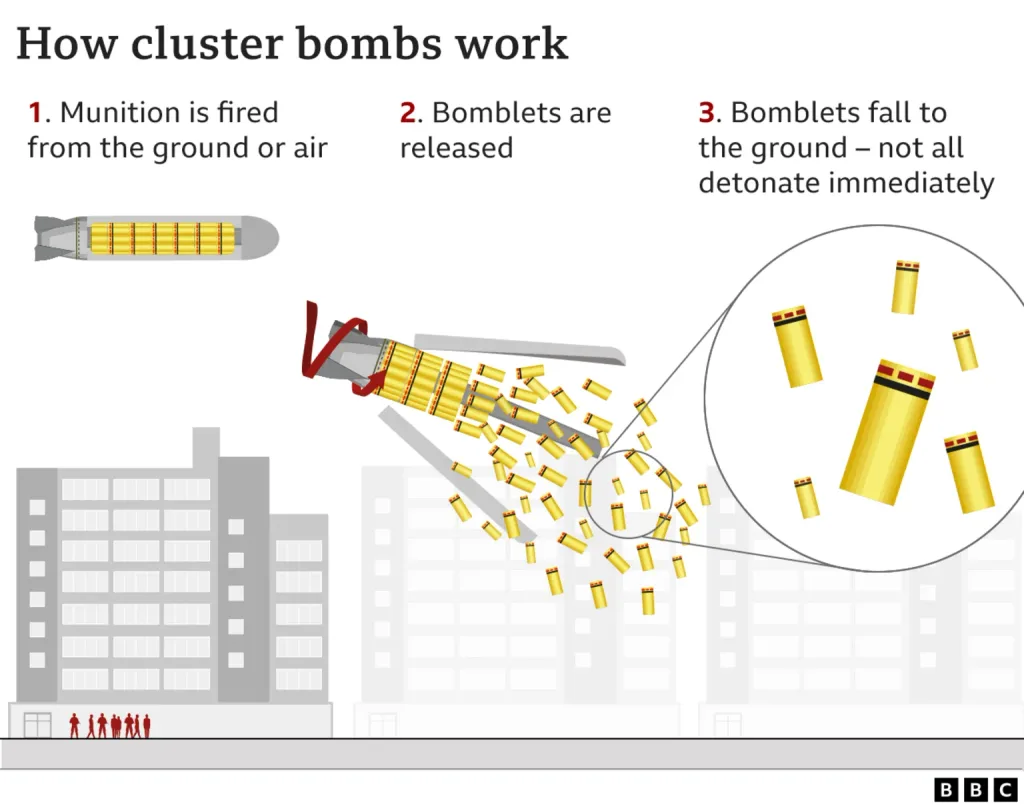
Cluster munitions are munitions designed to disperse or release multiple submunitions over an area that may extend to several hundred or even several thousand square metres. Under disarmament law, the term cluster munitions encompasses the dispenser or ‘parent munition’ and the submunitions it holds. Cluster munitions are fired from the ground (e.g. by artillery or rocket) or air dropped. Each submunition incorporates a high explosive charge. Many have a shaped charge as well as a fragmentation effect. The fragmentation effect kills or seriously injures personnel and damages military matériel; the shaped charge is designed to penetrate tank armour.
Producers
Cluster Munition Monitor reports seventeen producing States: Brazil, China, Egypt, Greece, India, Iran, Israel, North Korea, South Korea, Myanmar, Pakistan, Poland, Romania, Russia, Singapore, Türkiye, and the United States.
Use and Humanitarian Impacts
Civilians are of course often killed or seriously injured when the submunitions land. But unexploded submunitions – those that do not detonate as intended on impact – are especially dangerous for civilians as they remain active for years or even decades afterwards. For instance, tens of millions of submunitions remained unexploded from the 280 million dropped over Laos by the United States during the Vietnam War in the 1970s. They continue to be cleared – and to kill – to this day. In 2024, casualties from cluster munition attacks and unexploded submunitions were recorded in nine countries by the NGO Cluster Munition Monitor.
Cluster munitions are being used on a huge scale by both Russia and Ukraine in their ongoing warfare, causing significant casualties. Thailand used cluster munitions against Cambodia in 2025. Iran used cluster munitions against Israel in March 2026 (though mainly to confuse air defences). Pakistan is alleged to have used cluster munitions against Afghanistan in 2025.
Mine Action Review tracks progress in clearing unexploded submunitions worldwide. It reported that as of August 2025, 24 States along with Kosovo and Western Sahara were still affected. In May 2026, Mali was potentially added to the list of affected States (see below). Since 2010 (when the Convention on Cluster Munitions entered into force), fourteen States have completed clearance – Angola, Bosnia and Herzegovina, Colombia, the Republic of Congo, Croatia, Georgia, Grenada, Guinea-Bissau, Montenegro, Mozambique, Norway, Thailand, the United Kingdom, and Zambia.
Applicable Legal Rules
International Humanitarian Law
As with all weapons, use of cluster munitions is subject to the IHL principle of distinction and the principle of proportionality in attack.
It is sometimes claimed that cluster munitions are inherently indiscriminate weapons because they cover a wide area, but that is not legally correct. What is true to say is that use of cluster munitions in populated areas is often indiscriminate and that the weapons very often have indiscriminate effects.
In the Martić case before the International Criminal Tribunal for the former Yugoslavia (ICTY), the Trial Chamber called the firing of submunitions from a launcher against Zagreb an indiscriminate weapon. ICTY Martic judgment, 2007, para 463. On appeal, however, the ICTY subtly corrected the error and confirmed it was an instance of indiscriminate use (para 247).
Disarmament Law
The Convention on Cluster Munitions (or CCM) prohibits the development, production, stockpiling, transfer, and use of cluster munitions by all its States Parties. No reservations are possible to its provisions.
States are given eight years to destroy stockpiles (with the option to ask for four-year extensions) and ten years to clear unexploded submunitions from their territory (with the option to ask for five-year extensions).
As of 1 June 2026, 112 States were party to the CCM. Lithuania withdrew from the CCM in 2025, the first and only State Party to do so.
Article 2 of the CCM defines cluster munition as ‘a conventional munition that is designed to disperse or release explosive submunitions each weighing less than 20 kilograms, and which includes those explosive submunitions’.
Excluded from the CCM are landmines; submunitions designed to dispense flares, smoke, pyrotechnics or chaff; submunitions designed to produce electrical or electronic effects; and submunitions ‘designed exclusively for an air defence role’. This is believed to cover the Starstreak surface to air missile produced by Thales in the United Kingdom.
Article 2(2)(c) excludes a munition that, ‘in order to avoid indiscriminate area effects and the risks posed by unexploded submunitions, has all of the following characteristics:
(i) each munition contains fewer than ten explosive submunitions;
(ii) each explosive submunition weighs more than four kilograms;
(iii) each explosive submunition is designed to detect and engage a single target object;
(iv) each explosive submunition is equipped with an electronic self-destruction mechanism; and
(v) each explosive submunition is equipped with an electronic self-deactivating feature.’
These sensor-fuzed weapons are in effect autonomous weapons that are permitted by a disarmament treaty. The exclusion in Article 2(2)(c) encompasses the SMArt 155 munition produced by Rheinmetall in Germany. The Suchzünder Munition für die Artillerie (SMArt) 155 projectile consists of a thin-walled shell body, a base plate, an ejection unit, time fuze, and two functionally identical submunitions. A SMArt 155 mm round contains two submunitions. Once the munition reaches the target area, the two submunitions are released and descend under a parachute and their sensors start looking for enemy tanks. When one is identified, the munition is activated and the explosively formed penetrator hits the tank from above. An upgrade programme was ongoing at time of writing, with production of modernized ammunition planned for 2027.
International Human Rights Law
Unlawful use of cluster munitions would violate the right to life and/or the right to freedom from inhuman treatment.
IHL Violations
Israel used cluster munitions, many indiscriminately, in southern Lebanon in 2006.
Saudi Arabia used cluster munitions, many indiscriminately, in Yemen from 2015 to 2018.
Despite denials by both States, cluster munitions were repeatedly used indiscriminately over populated areas by Armenia and Azerbaijan in the armed conflict in 2020 over Nagorno-Karabakh.
Both Russia and Ukraine used cluster munitions indiscriminately over populated areas on multiple occasions in earlier years (from the start of Russian aggression in 2014). Use has been very significant since the Russian invasion at the end of February 2022. The United States supplied Ukraine with cluster munitions from its stockpile.
Disarmament Law Violations
The first serious violation of the Convention on Cluster Munitions occurred in May 2026. Unexploded Russian-made submunitions were found in a village in northern Mali despite Mali being a State Party to the CCM. The submunitions are believed to have resulted from airstrikes by the Malian Air Force on 17 May 2026.
It is suspected that the cluster munitions were provided to Mali by Africa Corps, a Russian military group under its Ministry of Defence, which has been contracted by Mali to assist its armed forces (FAMa) in suppressing domestic rebellions. Africa Corps has engaged in military operations together with FAMa. Under the international legal rules of State Responsibility (see Draft Article 5), this would make Mali responsible for acquisition, stockpiling, and use of cluster munitions – all serious violations of Article 1 of the CCM. Africa Corps has been contracted by the Malian military government and is thereby acting as a State agent of Mali.
Cluster munitions fall within the material scope of the Arms Trade Treaty, meaning that their transfer is subject to the ATT’s risk assessment requirements, including the prohibition on transfer where the exporter knows they will be used to commit war crimes.